
The Mat Pilote clings to a rocky promontory where the Laïta opens to the Atlantic, white stone against black cliff, surrounded by blue waters on three sides. It has stood since 1847, and remains there still on nautical charts nearly two centuries later, guiding mariners as it always has. The road that bears its name and leads to it, the Chemin du Mat Pilote, runs along the scenic coastal path that follows the estuary towards Quimperlé—the Laïta becoming a shard of sea stretching inland, medieval town meeting tidal water.
Captain Julien Fénoux designed it as an expression of French Enlightenment ingenuity—rational innovation to save lives at sea. A fifteen-meter semaphore rose from its tower. When storms kept pilots ashore, men stationed here moved the great arrow overhead, signaling safe routes through the shifting sands of the Pouldu bar. Brilliant in its simplicity, technological in its precision. Several were built at critical points along the French coast. Only a handful survive. Fewer still remain intact. This is one of them—and unlike any other, it preserves its pilots’ quarters. Built far from any town, the men who operated the semaphore lived here, keeping watch through the nights. House and tower remain together, as they were meant to be: the only mat-pilote where you can live within the history it holds.
The structure reveals itself in all weather, and all weather here is extraordinary: the lulling summers of southern Brittany when light plays on calm water, and the raging Atlantic storms breaking on the rocks beneath—the same storms that once made this beacon a saviour and a hope. From within its metre-thick granite walls, opening to breathtaking views in all directions, you witness both the gentle and the violent, the maritime reality that has shaped this coast for millennia. The stone itself is protection and observation post, shelter and command.
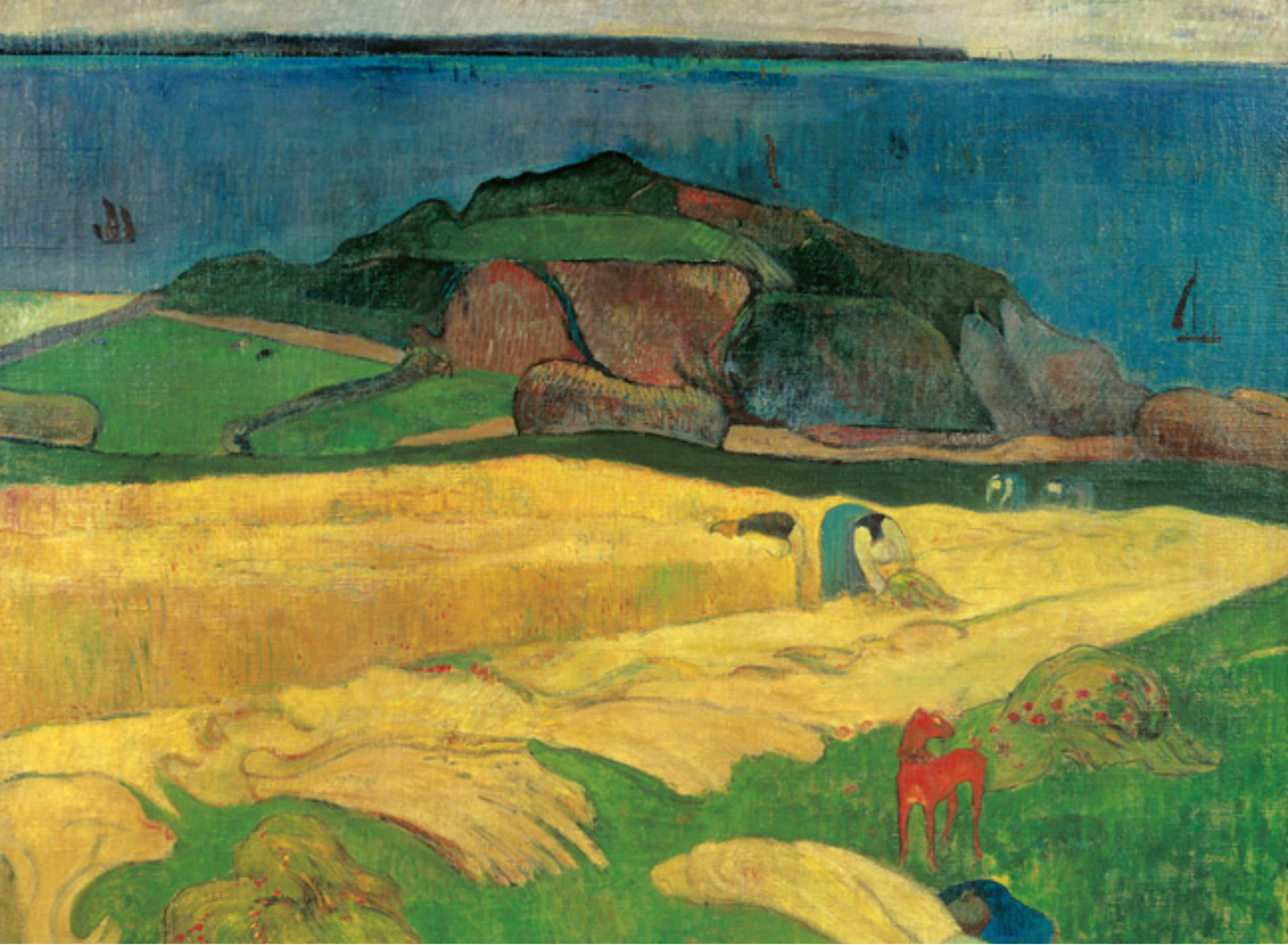
The views from its windows are the ones Gauguin painted obsessively when he made Le Pouldu—the dark pool, Ar Pouldu in Breton—a central subject of his art: the promontory with its white house against dark rocks, the orange-pink beaches and turquoise water, the golden harvest fields meeting the sea, the tidal creeks where river confronts ocean. That peculiar coastal light—the dramatic convergence of land and sea that surrounds the Mat Pilote on all sides—drew him back to paint these scenes again and again. And at night, when stars emerge over this peninsula thrust into the Atlantic, the darkness he captured becomes something else entirely: a vault of stars reflected in black water, the heavens sailors once navigated by.



For seventy-seven years ships that might have broken on those sands and rocks passed safely into the river instead. Decommissioned in 1924, the Mat Pilote became what such places become when their work is done: a keeper of memory.
In 1975, to preserve it—and the memories it stirred in him—our grandfather bought it. Nom de guerre Claude Rivière—a young student who joined the Resistance, just “Kikli” for us—had stolen German coastal defense maps from a semaphore in Paimpol in 1941, plans that reached London and made Operation Fahrenheit possible. Thirty-four years later, when he found the Mat Pilote for sale, he saw his younger self. The one who had once broken into semaphores to seize intelligence that would save lives. The tower called to him. He answered. Deep in the rocks below, hidden from most eyes, a German bunker from that same war remains: occupier and liberator sharing the same stone promontory, history layered upon history.
These are the memories we aim to preserve. The maritime memory, collective, known to anyone who has ever watched the sea. The artistic memory in Gauguin’s canvases of these exact landscapes. The memory of French technical innovation, of Enlightenment rationalism harnessed to save lives. The wartime memory, Resistance and occupation, courage and consequence, a bunker in the rocks and plans smuggled to London. And our private memory too—our childhood, our grandparents’ home, now being restored by three brothers who understand what must be done.
We are making it whole with a premise both simple and sustaining: guests will inhabit this place, and their presence will fund its perpetual conservation. Not commerce but preservation. Not profit but continuity. The Mat Pilote will guide its own future as it once guided ships: carefully, purposefully, across generations. Because this is how monuments survive: by being used, carefully. By being inhabited, respectfully. By serving a purpose that ensures their preservation. The alternative is slow decay, which is no alternative at all.
Support the restoration. Experience the place. Sustain one of France’s last remaining mat-pilotes for the centuries ahead.